


































By Lucy Ogalue
Development partners and United Nations agencies have called for urgent reforms in Africa’s agricultural and trade policies to end the continent’s growing food insecurity.
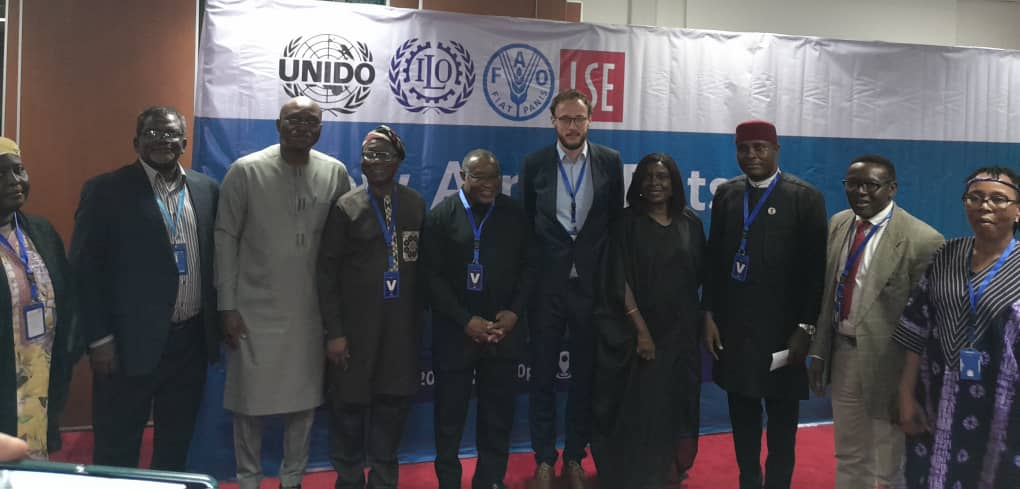
They made the call in Abuja on Wednesday at the presentation of the book “How Africa Eats: Trade, Food Security and Climate Risks” written by Prof. David Luke of the London School of Economics (LSE).
The event was organised by the Friedrich Ebert Stiftung (FES) in collaboration with the United Nations Industrial Development Organisation (UNIDO) and the International Labour Organisation (ILO).
Luke said Africa could not overcome hunger without changing the structure of its trade and industrial policies.
The professor said that the region must shift from exporting raw commodities to processing its produce for trade within the continent.
He said Africa’s vulnerability to global shocks was worsened by its dependence on imported manufactured goods, calling for regional food trade and climate adaptation to strengthen food systems.
Luke outlined key recommendations from the book, including the need to promote intra-African trade.
According to him, it will boost food production and productivity.
He urged governments to prioritise non-tariff measures that could have the greatest impact on agricultural markets, and to support smallholder farmers to commercialise and scale up production.
He also called for stronger adaptation to climate change, adequate financing for Africa’s Nationally Determined Contributions (NDCs), and a rethink of global food security discussions at the World Trade Organisation (WTO).
According to him, Africa’s food insecurity, which affected about 280 million people in 2022, is driven by weak trade structures, climate shocks and economic challenges.
He said boosting agricultural productivity and re-orienting trade flows would enhance food availability.
He further said that the African Continental Free Trade Area (AfCFTA) offered an opportunity to build a single market that supports food security across the continent.
The Resident Representative of FES in Nigeria, Mr Lennart Oestergaard, said the organisation supported the publication because it aligned with its mission of promoting social justice and inclusive economic policies.
He said FES had worked in Nigeria for over four decades and would continue to support initiatives that link trade, industrial development and decent work.
The Representative of ILO, Mrs Inviolata Chinyangarara said the organisation was committed to promoting decent work in agriculture and ensuring that food production supported livelihoods sustainably.
Also speaking, the Country Director of UNIDO, Mr Philbert Johnson, said industrialisation remained key to addressing food and employment challenges across Africa.
The UNIDO National Programme Officer, Dr Otu Osuji, said that investment in processing equipment, storage and cold-chain systems would help reduce post-harvest losses and improve food value chains.
A professor of Agricultural Economics at the University of Ibadan, Prof. Emmanuel Ogunkola, said African countries must make collective sacrifices and reform governance structures to transform agriculture and benefit from the fourth industrial revolution.
The event ended with a networking session where participants agreed to strengthen partnerships that would support policy advocacy, training and value-chain development across Africa.(NAN)