





















- AFRILAW trains Bayelsa rights defenders on extractive sector
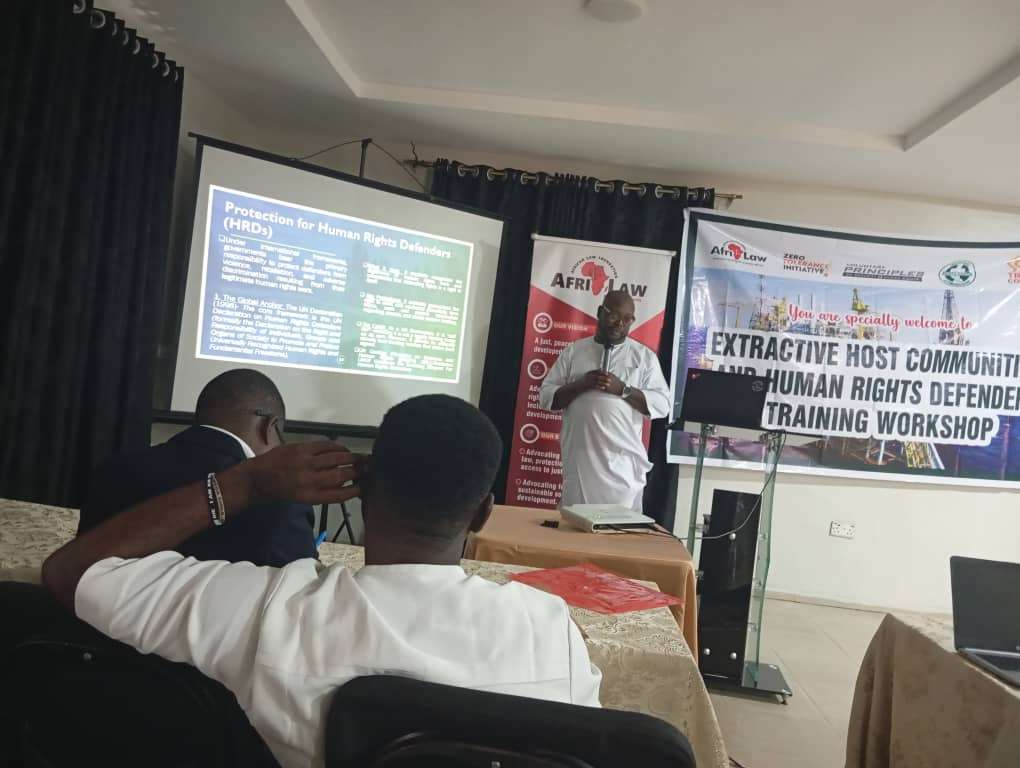
The African Law Foundation (AFRILAW) has trained 30 human rights defenders and civil society organisations in Bayelsa on rights protection and accountability in extractive host communities.
The training, held in Yenagoa, was organised in partnership with the Zero Tolerance Initiative, Voluntary Principles Initiative (VPI) and True Cost Initiative, with support from the National Human Rights Commission (NHRC).
Mr Chinweike Okereke, Executive Director, AFRILAW, said the workshop was designed to equip participants with knowledge and tools to effectively promote and protect human rights in Nigeria’s extractive sector.
Okereke said businesses had a responsibility to respect human rights, while human rights defenders had a duty to advocate peacefully for justice and the protection of affected communities.
He said being a human rights defender was determined by actions rather than titles, adding that journalists, community leaders, civil society groups and individuals could qualify by promoting and protecting human rights.
Okereke, however, cautioned defenders against actions that violated the rights of others, stressing that peaceful advocacy was fundamental to legitimate human rights defence.
He said the training also sought to strengthen collaboration between human rights defenders and the NHRC, which he described as an important institution for protection and redress.
The participants who shared their experiences in the interactive workshop resolved to join forces to enhance the advocacy for human rights
Dr Eugene Baadom, Bayelsa Coordinator, NHRC, who represented the Executive Secretary, Chief Anthony Ojukwu, SAN, said host communities continued to face environmental degradation, oil spills, gas flaring, pollution and displacement.
Baddom said such activities could undermine fundamental rights to life, health, food, clean water, livelihood and a healthy environment.
He said the NHRC had the mandate to investigate alleged violations, mediate disputes, monitor human rights conditions, conduct research and advise the government on human rights matters.
According to him, victims, human rights defenders, CSOs, lawyers, family members and authorised representatives can submit complaints to the Commission through its offices, written petitions or the H-RIGHT online platform.
Bado said the Commission could resolve complaints through mediation, conciliation, panels of inquiry and oral hearings, while serious or systematic violations could warrant formal investigations.
Speaking on the VPI, Mrs Wisdom Friday, a lawyer, said the initiative provided an international framework for managing security in extractive operations while respecting human rights and fundamental freedoms.
Friday urged defenders to assess risks before engaging extractive companies and said companies should properly vet, train and supervise private security personnel.
She said human rights defenders should not be regarded as security threats, but as early warning signs of potential conflicts, stressing that legitimate non-violent advocacy should be
protected.